Ten Questions for David Ian

May 26, 2026
Every live sound you will hear at Gamera vs. Zigra — the underwater thrashing, the xylophone turtle shell, the footsteps and punches and alien shark vocalizations — comes from someone on stage hitting, scraping, or squeezing an everyday object at exactly the right moment. That someone is David Ian and his three-person Foley crew. We sent him ten questions. He answered with enthusiasm, spreadsheets, and at least one revealed secret of the trade.
Question 1: Gamera vs. Zigra features an alien shark, a giant turtle, and underwater combat. Walk us through your toolkit for this one. What does “alien shark” sound like, and what did you raid to get there?
We have some water thrashing props that we can use, a glass bowl with a drain plunger with holes cut in it to make water sound especially noisy, as well as some other hand-held props that can help with shark attack noises. To make particularly alien sounds we often use a flexatone and a sort of theremin sounding gig — mostly, though it depends if we’re talking East Galaxy or West Galaxy alien shark. There‘s a definite difference and it would be embarrassing if we got it wrong.
Question 2: Live Foley is inherently a high-wire act. What‘s the most spectacular thing you’ve ever broken, spilled, or launched across a stage in the name of authenticity?
I think the most memorable was for Theater of Blood for Willamette Radio Workshop, where a murderous character strangles their victim. I was doing “team sound effects” with my girlfriend at the time, and so at the murderous moment I grabbed her by the neck and threw her onto the Foley table and fake-strangled her right there in front of the audience. We have subsequently married since then.
Question 3: There’s a scene in this film where Zigra plays Gamera’s shell like a xylophone. We’ll just leave that there. What are you planning?
I have had, for many years, a small set of music chimes, as space and cartage is always a premium for live sound effects. But recently I was gifted by a very thoughtful and alert friend a set of “second-hand” full-sized xylophone chimes, and considering the size and scope of this project and the subject, I think this is the perfect opportunity to debut that set.
Question 4: The Gamera films were famously cheap, and the sound design reflects that. Do you feel a professional obligation to improve on what the original crew did, or is honoring the original schlock part of the art?
Our sound design serves an entirely different purpose on the live stage than the original crew. We have to do all the sounds in every scene in real time, with the confines of space and props available on stage in front of a live audience. We don’t have the luxury of using a full-sized car door or walking up and down a real staircase to get the sounds we need, and we must move at breakneck speed to be prepared for the next scene, which may be a completely different setting — underwater, in a desert, in a newsroom office. We have previously done live film sound designs with assistants whose entire job was to remove props from the past scene and set props for the upcoming scene; the pace is so fast. Imagine trying to do this musically where the musicians have to change instruments for every scene. But we’re not above some schlock to be part of the live experience.
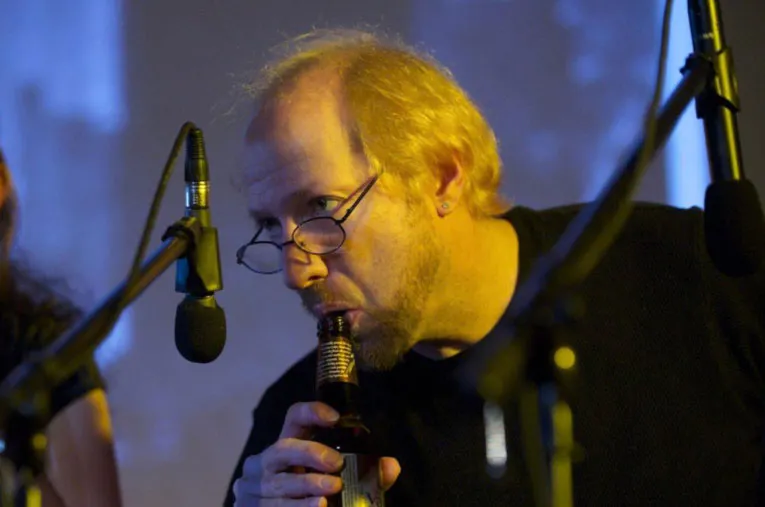
Question 5: Every Foley artist has a go-to material that sounds like nothing and works for everything. What’s yours?
You want me to reveal secrets? Okay, but you’re sworn to secrecy by the Revered Foley Artists Code! Some of them have names. Mr. Squeakers is a good-sized metal barn door hinge that ALWAYS delivers a good metal screech on command, and at different pitches, too. Mr. Schlurkie is a child’s toy of squeezable rubber filled with water that allows me to give water sloshing sounds right up to the microphone without getting the mic wet — very important for live work. And for Turkish Rambo last year, which had many scenes of people running through the “jungle,” I strapped a cheerleader’s pom-pom to a fake branch of silk eucalyptus to account for running through tall grass, forest underbrush, and falling through tree branches. There’s more, but you’ll have to come see the show to see them in action.
Question 6: How do you prepare for a film you’re performing live? Is there a scouting process, a rehearsal logic, or do you show up with a bag of stuff and trust yourself?
I’m German, so I use spreadsheets. Using a time ticker for the film, I log all the sounds needed and the times they must come off. Then, the next column, I identify the props needed to create that sound, and if none are immediately available in my “Fibber McGee Closet,” I make notes as to what I need to construct in order to make that sound, then I go shopping. The Home Depot people know me as “that guy who is making noise banging things together in the plumbing department again.” The Ace Hardware people are a little more uptight, though. Then, since we are working as a team of four, I have to assign the parts to the different Foley Artists in the team; if one person uses the mini-door unit, they use it all the recurring times too — we don’t have time to pass props back and forth. So they each get their own column on the spreadsheet with a sound, prop, and a time on it. After some rehearsing, you get into a rhythm of when things are intense and when they get easier. Some sounds are merely background fill-in for the scene going on (like typewriter for a newsroom, or tall grass blowing in the breeze), some are featured sounds that are very specific and must be done exactly on time. An explosion done late can give you the wrong kind of comedy.
Question 7: Live Foley puts the audience in on the joke in a way that studio Foley never does. How does that change what you’re trying to accomplish?
It sounds counter-intuitive, but doing live film sounds is very visual. People love to see the props manipulated that go along with the story being played up on the screen. I had one director with the idea of having us do footsteps by walking on a miked board on the ground, but I pointed out that meant you couldn’t see what we were doing, and it was more entertaining to see us bang shoes together in a walking rhythm up at the table microphone. Plus, it was prohibitive if we needed to do a variety of shoes, boots, high heels, etc. We have to figure out clever ways to provide the sounds of a scene with hand-held props or small devices on the table, and the variety and different ways they are used is a delight for the audience to watch. Explosions are balloons filled with beans banged together; chambering a round in a gun is a brass door handle unit manipulated in rhythm; sustained wind is a slatted cylindrical barrel turned under a heavy piece of fabric. There are clever props used, and also some skilled technique necessary for the prop to actually give its intended sound. It’s entertaining to watch, and we enjoy providing that entertainment.
Question 8: What’s a sound that filmmakers consistently get wrong in post-production that you could fix in thirty seconds with the right object?
Well now, the filmmakers are pros at what they do, but sometimes they are asked to do some silly things. Westerns will often have gunfire with a ricochet that would be impossible; fight scenes have punches that, if you go by the sound, would kill a water buffalo; and don’t get me started on sound effects in space! I mean, don’t get me wrong, I love my Star Wars and Star Trek, but climactic laser dogfights and Death Star explosions just wouldn’t be the same if they were done in the correct silence of space. So we suspend our disbelief for all of these faux pas for the sake of the dramatic effect.
Question 9: Gamera is famously a friend to all children. Has this film changed your relationship with large fictional turtles in any meaningful way?
My hope is that there will be less bullying or endangering of children with the knowledge that there is a large, monstrous, flame-jet-emitting turtle who is their advocate and protector. I endeavor to spread this knowledge far and wide. Plus, make lots of Gamera sounds to keep villains and bullies paranoid and scared.
Question 10: What’s the one thing you’d never bring on stage, no matter how good it might sound?
I would never bring an alien shark on stage. Even if the sound was spot on, you might not get it to go on cue, and possibly you’d have to feed it in the course of the evening and that might get messy. I’ve got the Foley Crew and Mr. Schlurkie, and between us we should be able to account for all the alien shark sounds required. Come watch, come see, and do what some do at these events — close your eyes and listen.