Ten questions for Lisa Lipton, clarinetist and co-producer of “Gamera vs. Zigra”

May 18, 2026
Lisa Lipton has been part of the Gamera story since the beginning. As a clarinetist and co-producer with Filmusik—the live cinema ensemble that originated this format at the Hollywood Theatre—she was in the room when Gamera vs. Zigra first came to life onstage in Portland. Today she serves as Executive Director of 45th Parallel Universe, one of the city’s most adventurous chamber music organizations, and as a host on All Classical Portland. She brings to this conversation both the muscle memory of someone who played the score and the institutional perspective of someone who has spent a career building the infrastructure that makes ambitious live performance possible.
1. The clarinet in the room: Live cinema scoring isn't the obvious home for a clarinetist. How did you find your instrumental voice within the Filmusik concept, and what did the clarinet bring that other instruments couldn't?
I think as a clarinetist I’ve struggled my entire time with that instrument to force myself to fit into one dynamic, one genre, one specific club and just be one thing or one type of player. If you’ve seen me in real life, or we’re friends, you know that in the same two-day span, I could show up to something head to toe in sequins, a feather boa, a legal suit appropriate for a court room, or leggings with skateboards all over them… and I wear all of this with the same confidence level. I think my clarinet playing is kind of like that. I play classical, I play weird avant-garde chamber music, I play for studios for commercials and indie pop musicians, and I play all kinds of jazz and klezmer–including unstructured “free jazz” or “free music.”
When you play a film score, to do so really well when it is live, you have to adapt to the mood of the scene, the comedy of the character, or be able to dig deep musically and produce something that is emotionally moving or outrageously hysterical. I revel in the opportunity to live my personality through a production. I think a lot of instruments could play this role well, but may not have the ability of our incredible range. We have many octaves (a 4-octave range), and there's also a lot in the clarinet family; bass clarinet, basset clarinet extension, Bb, A, Eb, and God forbid, as a last resort… alto clarinet… no shade to the alto players out there, but you guys are total aliens!
I always tell people too, that clarinet is closest in timbre and range to the female human voice, and just like people seek faces in everything we look at, we respond really well to instruments that have mimicry similar to our own sounds.
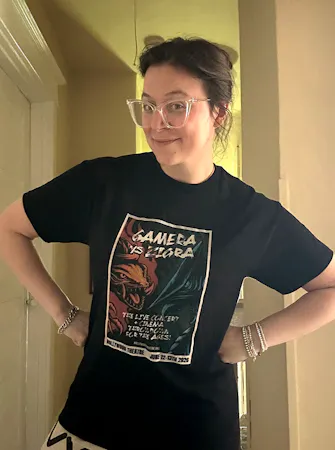
2. Performing and producing simultaneously: You were inside the show as a performer while also carrying producing responsibilities. How did you manage that split, and which hat was harder to wear?
I’ve answered this question in many different ways over the years… but I think there are two really simple answers that create one complex human.
a.) I have very high levels of ADHD with executive function still intact on an incredible level. This means that I have spreadsheet skills and grant writing skills as well as playing skills at a high level but on the not so fun side of it, I also have a laundry problem, a million coffee cups at my desk, and if I come up with an idea in the middle of a task I might just get up and follow that for a little bit.
b.) I think my personality is innately all of these things. I think about a memory from pre-school where I was not getting the kind of play time, attention, and action I wanted out of the morning social time before “floor time” AKA when we would get books read to us on the carpet. So, I patiently waited until floor time was over to stand on the opposite side of the teacher floor time area, and proclaim to my classmates “Hey everyone! Look over here!” and started to enact a scene with a My Little Pony in hand, hoping to entice everyone over to me. You might call that anti-authority from a young age, but I was just looking for the timing of opportunity to create something that not only appealed to my whims, but also involved the larger group.
Shout out to my teachers for not squashing that public partnership desire from a young age, and shout out to my pet earthworms from pre-school whose names were Sprinkles and Diamonds.
3. The first Filmusik show: What do you remember about the first time you performed live to picture in front of an audience? What broke, and what worked beyond all expectation?
The most amazing thing about Filmusik that has not changed one bit, even to this day, and still blows my mind is how exciting it is to see music, live actors, and live sound effects of Foley all at the same time coming together like an elaborate and exquisitely seamless puzzle. It’s so incredible to me that all these very different aspects of production come together without the fluff of costumes, the magic of set changes, and large amounts of rehearsal to create something that still really feels like magic, like a bunny rabbit being pulled out of a hat. If you’re not singing the Gamera vs. Zigra theme song with us by the end of this movie, maybe we should check your pulse! I’m kidding… but, in all seriousness, it kind of feels like how I imagine opera used to feel to people; this ultra sensory overload experience with heightened drama, and unimaginable plot lines that moves quickly and is a delightful escape from the world around us. Also, what broke, and what always breaks, is that we have to do it all over again next year. I think that is the mark of something really fucking good. But, it is also a lot of work and it means the bar gets raised again and again. You should come and see what this complex and exciting production is all about. It also takes me back to riding the Star Wars ride at Disney Land shortly before my 6th birthday. It was the first time I had experienced a ride where there were physical sensations like wind, and where I didn’t know what would happen next, but I truly felt like I was in the movie!
4. Building the ensemble culture: Filmusik had a specific collective energy onstage. How much of that was designed, and how much just emerged from the particular people in the room?
I think there was never a specific cultural design, but, when you have all the artistic odd balls from various different aspects of the arts in one production, it ends up naturally feeling like the weirdest, coolest, musically centered carnival! Sam Mowry (RIP) was a big part of the slapstick comedy feel as was Galen Huckins. There’s sort of a camaraderie and summer camp feel to the experience, and, actually I think the audience feels that in a positive way. Hey, wanna join our Scordatura summer camp? Ask Ron Blessinger how YOU TOO can become a part of this weird menagerie ;)
5. The Hollywood Theatre as collaborator: That venue has its own gravitational pull. How did the physical and cultural character of the space shape what Filmusik became?
The Hollywood Theatre is kind of the heart of this. Without that feeling of old school theatre, old school stage, curtains, drama, the popcorn smell, the lighting in there, it wouldn’t be the same. We need gathering places where art feels like it just pops out of the cracks in the wall and that you might have weird conversations by the concession stand and that you’ll make a friend out in the lobby who tells you about some other weird film or music thing you’ve never heard of but you’ve also discovered you were both at the same obscure punk show. Centers for art are needed for this kind of beautiful extroverted experience to happen and exist! Hollywood is at the center of that for film in Portland. It always has been.
6. Gamera vs. Zigra specifically: What's your memory of that production, and what made it distinctive within the Filmusik catalog, and what was the audience like on those nights?
This is one of the best memories of my life. It happened in a park just off of Hawthorne on my 22nd birthday. Over 2,000 people were there and Justin (he wrote the musical score for this) was conducting and directing. He started to conduct and I got nervous and scared because I really barely had my reed on my mouthpiece and then within the first few seconds, I realized he had prepared the orchestra to play happy birthday to me and got the entire audience to sing along. It set that performance up to have really fun energy. All of the kids present were very excited for the monster rumbles and the weird ocean scenes.
7. The producing side nobody sees: What was the unglamorous infrastructure work that made these shows possible, and what did you learn about producing live events that you couldn't have learned any other way?
In a way, I grew up as a baby administrator doing these shows. I learned that you will always likely have a technical issue and it is how you recover and move on and how quickly that you can do that that can still make an experience great for everyone. I also learned that the energy from the audience makes something truly incredible and that is something that you don’t think about in rehearsals – you learn it in real time. Scheduling, contracts, and continuing to get all the ducks in a row for a production to be possible will always be something that just takes a little time, diligence, and passion for not leaving anything or anyone behind, but the reward of a successful and easily run production is not matched by anything else I professionally do. There is no other way to learn how to do a big show from every aspect of it than to just do it.
8. The clarinet moment: Was there a specific passage or scene in any Filmusik production where you felt the clarinet unlocked something in the film, a connection between the instrument and the image that surprised even you?
YES! I have always felt like when the clarinet is running with percussion in an action scene, or there is a sentimental and emotionally melodic passage between clarinet and what's on screen, it can help you be more present in that moment. In Turkish Rambo, the jungle scenes, and chase scenes were that for me- so fun and silly and energizing! In Gamera, it’s a mix of when Gamera re-emerges to help earth and the kids from their problems, and some of the villain scenes with Zigra, where, honestly, Zigra makes some great points about things earthlings need to take better care of. I also think the scene in Gamera where they are playing with Seals is so outrageous, but that it really works for getting you in touch with the playful child self within.
9. A decade out: Looking back at the Filmusik run from ten years' distance, what do you understand about that work now that you couldn't see while you were inside it?
In the moment and at the time of first doing these I couldn’t see how important it is to do big productions like this and to keep that alive and keep all these communities together. As economic strain continues, and we enter a landscape of a growing city, it can be hard to get people to see the value of doing big productions with small organizations. It is really critical to the arts ecosystem for these things to happen. Productions like this are the biggest community effort organized by musicians and artists who are not connected to large administrative infrastructure and those things always push the boundaries of art in a beautiful and interesting way that those artists and other artists learn from and create better and better art from.
10. To House of Scordatura: What would you want to say to the company reviving Gamera vs. Zigra: what should they protect, and what should they feel free to make their own?
I am so happy that House of Scordatura is bringing back these large Filmusik productions. It is bringing film and music together in a unique way, and is super charging the entrepreneurial spirit within the Oregon Arts and Culture scene right now, we need it!!!
I feel like all of these productions should evolve and change with who is doing them – film and music together as art forms especially. I feel in this setting it is always about the musician behind the stand, and not as much about the integrity of every note. Composers might fight me on that, but, in a live setting, I think the personality of the player matters just as much as the score! There is so much improvisation in many of these scores, it allows for (I think appropriately) the energy of the performance and the performer to react and really deliver.