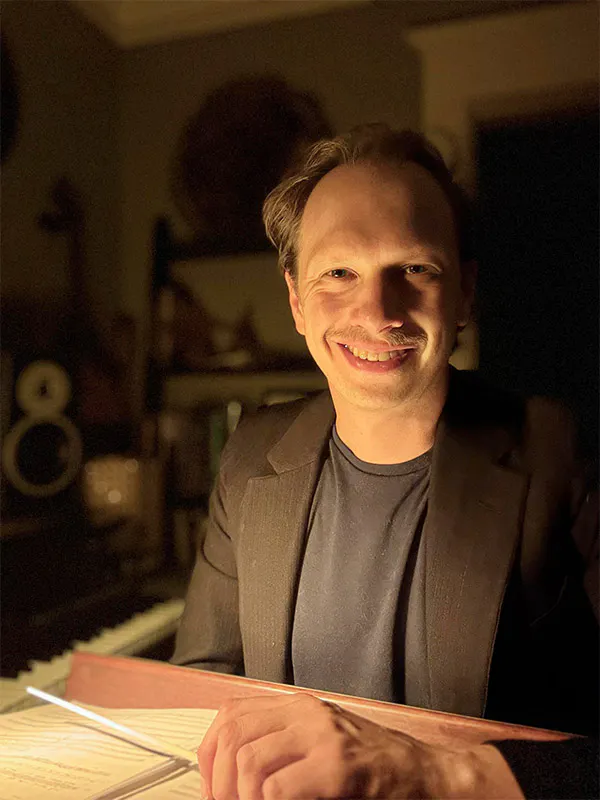
Ten Questions for Gamera vs. Zigra composer Justin Ralls

March 29, 2026
Ten years ago, Justin Ralls and his collaborators at Filmusik did something Portland hadn't seen before: they scored a 1971 kaiju film live, in a theater, in front of an audience. This June, House of Scordatura is bringing that score back to the Hollywood Theatre for three performances of Gamera vs. Zigra – and we asked Ralls ten questions about what it was like to return to the project, what's changed, and what it means to write music for a giant turtle.
1. First contact with the film — When you watched Gamera vs. Zigra for the first time as a compositional assignment, what was your honest reaction, and how long before you found the musical way in?
My first contact was when Galen Huck called me and asked if I’d want to do Gamera vs. Zigra. He had done a score to another of the Gamera films, but I had zero exposure to Gamera. My honest reaction was “what is this?” Is it a monster movie? A kids’ movie? Is this supposed to be funny? I really didn’t know what to think. Musically, I intuitively drew upon the 60s and 70s film music I know and love (Morricone, Mancini etc), but also the monster and sci-fi scores from the golden era. I started out sketching a “Main Title” theme, and for some reason when the Gamera title come up I heard a wordless soprano (probably because of Morricone and the original 1966 Star Trek intro - I think by Alexander Courage)
2. Scoring to picture vs. scoring for a room — Writing for a live ensemble performing alongside a film is a different problem than traditional film scoring. What constraints did the live context impose, and which of those constraints turned out to be gifts?
The biggest constraint, which is also always a gift, is getting a ‘cinematic’ sound out of a chamber ensemble, and I would say that was / is a gift because it’s much easier to write mediocre music with an orchestra than exceptional music with 5-7 instruments that has the same gravitas and dramatic weight. Playing and conducting live to picture is also much more fluid and fun and dramatic, with an emphasis more on raw artistry and musicianship than production and precision, which is the higher priority than traditional scoring in a studio. What we are doing is really a throwback to an older mid-century process and technique which is now almost completely lost from the industry.
3. The Gamera sound — The original Shunsuke Kikuchi score has a very specific mid-century Japanese character. Did you engage with it, argue with it, or try to forget it entirely?
I deliberately did not watch or listen to the film with its original score or dialogue - I wanted to approach it completely free. My own score’s mid-century sound is a response to the film’s style and pacing, but also because I probably share a lot of the same influences that Kikuchi did vis-a-vis classic film scores – though my score is not at all Japanese. I was actually surprised when I did listen back to notice how similar the dramatic beats and musical responses to some of the same moments were, which speaks to the universality of scoring and responding to picture.
4. Instrumentation choices — What’s the ensemble, and why those specific voices? Were there sounds you wanted and couldn’t have, or instruments you discovered only worked once you were in the room?
The original budget allowed a chamber group, about 5-9 instruments, so within that group you want to strike a balance of having your core “band” (bass, percussion, guitar) and then orchestral instruments that can both provide a diversity of colors but also a homogenized sound – clarinet, harp, violin, cello and soprano all add orchestral qualities. Harp really can make any small ensemble sound like an orchestra, because the range and ability of the instrument is so large. Likewise, harp and guitar create both melodic and harmonic possibilities and textures.
5. The comedy problem — Zigra is camp, but camp played straight. How do you score a film that's already funny without either condescending to it or ignoring the joke?
You play it straight. However, the film is fun and hopefully the music also reflects that.
6. Synchronization under pressure — Live music to picture means someone is always slightly wrong. How do you build a score that’s precise enough to land the hits but flexible enough to survive the night?
Well, I think the goal is to not be “slightly wrong!” I think the technique is to create dynamic cues and set pieces that work to support, but also provide counterpoint with, the film, without too many specifically detailed cues. This was the technique of silent film, to create “mood music.” That said, contemporary films demand narrative arc and scene precision, so it’s always a balance and a fun challenge.
7. The moment that surprised you — Was there a scene where the music found something in the film you didn't expect – where the score revealed something the original production never intended?
The moment where Zigra chides the humans on ocean pollution and fishing is, unfortunately, more relevant today than even in 1970, and inspired music that is certainly weightier and more contemplative than the original.
8. Working with House of Scordatura — What has the collaboration with this production been like, and how has the show changed from your first draft to what audiences will actually hear?
HoS has taken this production to the next professional step. We not only have phenomenal musicians and production team, but also more technical capabilities to sync and have a controlled, but still wild, live performance experience.
9. The revival factor — This score was written for a specific cultural moment a decade ago. Have you revisited it, and if so, what did you change?
Yes, I’ve learned a lot and improved my own craft since first composing this score, and have also honed my sense of dramatic beats and narrative, so this revival will include lots of revisions to the orchestration, as well as adding and refining cues that were either previously improvised or just hastily constructed. I’ve also gone back and integrated both my original theme, as well as quotes from the OG Gamera theme in the original films.
10. The film you'd score next — If House of Scordatura called tomorrow with a blank check and an open catalog, what's the film you'd want to tackle?
There are several projects that take these live production elements in new directions. Mario Bava’s Hercules in the Haunted World, aka Hercules vs. Vampires is a gorgeous, wild Italian sword-and-sandal / horror film that I think would be great revisited. If the check was truly blank, I think going back to the pre-code horror films such as Frankenstein (1931) or Spanish Dracula (1931) – which was filmed with the same sets and script as the Bela Lugosi film but with different actors – and composing new symphonic scores would be very interesting and a great challenge. None of the early horror films had scores, because the technology wasn’t there yet to integrate all the sound, but they all have expressionist filmmaking and theatrical melodrama that with live performance could be taken to new heights of drama and spectacle.